


The service
Where Ascendant fits
Ascendant sits in the space many growing private businesses need: technically credible, commercially aware and still human to deal with. Smaller firms can be personal but under-structured. Larger firms can be technically deep but layered and expensive. Ascendant’s opportunity as an audit firm is in the middle: clear process, continuity of understanding and sensible fit.
The fee question
How much does a statutory audit cost?
There is no reliable universal price for a statutory audit because the fee depends on the company’s size, complexity, audit risk, records, sector, group structure, deadlines and readiness. Turnover matters, but it is only one input.
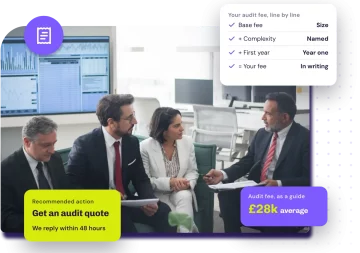
£28,000
our average audit fee, as a guide
Before international elements or higher complexity, and often lower for a single-entity, UK-only business with a ready finance team. Whatever yours is, it is built from this framework and put in writing with its assumptions.
Key points: Audit fees are driven by audit effort. The biggest controllable cost drivers are record quality, preparation, responsiveness and avoiding surprises after the scope has been agreed.
Not just size
Why turnover alone is not enough
Two companies with the same turnover may have very different audit profiles. One may sell simple services, reconcile monthly and have clean records. Another may trade through marketplaces, hold stock, process thousands of transactions and have multiple payment processors. The second audit will take more work.
Turnover alone doesn’t decide whether you need an audit either.
Fees and scope
What moves an audit fee
We price from a framework. Here is what drives the number, and what would change it.
- Base: size and structureTurnover, balance sheet, headcount, entities and locations, year-end timing and reporting deadlines set the starting point.
- Complexity driversStock and WIP, contract accounting, group and overseas elements, financing, and judgement-heavy areas such as estimates and going concern.
- Readiness adjustmentStrong reconciliations, mature systems and a responsive team make an audit cheaper to run. The fee should reflect that, in your favour.
- Delivery pressureCompressed group deadlines, peak-season year-ends and catch-up work add real cost. We say so upfront, not through surprise billing.
Explained, line by line
Your fee, as a bridge
Every element is named, sized and agreed before work begins. The first-year block drops away in year two.
- Base feeSize and structure.
- + ComplexityStock, group, judgement.
- + First-year workYear one only.
- − ReadinessClean records cut cost.
- = Your feeAssumptions in writing.

See your own bridge. Tell us your year end and turnover, and we’ll scope your audit.
Year one
Year one is bigger, and we price it honestly
In a first audit, or your first year after switching, prior-year unaudited opening balances must be examined and your systems documented for the first time. It is in our quote from day one, as a separate line, and it does not repeat in year two.
A first-year audit often includes setup work: understanding the business, systems, controls, accounting policies and prior-year balances. If the previous year was unaudited, opening balances may need additional evidence.
Agreed in advance · illustrative example
If the work changes, the conversation comes first, never the invoice
What changed
A second entity was added to the group during the year.
Why it matters
Additional statutory audit work and intercompany testing.
Fee impact
+£3,200, explained and agreed before any extra work began.
Staying in control
What makes an audit cost more, and what keeps it down

How delays increase cost
Delays build from small gaps: a reconciliation does not agree, a contract cannot be found, stock count evidence is incomplete, a forecast has no downside case or a query sits unanswered. Each delay creates follow-up, review time and timetable risk.

How to keep audit costs under control
Close the year-end properly, reconcile every balance sheet account, agree the PBC list (the documents your auditor will ask for) before year end, prepare evidence for estimates, identify complex contracts early, allocate owners and answer queries quickly.
Checklist
What a good proposal includes
A proposal that only gives a number is harder to compare.

The scope

The timetable

The assumptions behind the fee

Client responsibilities

Triggers for additional fees

The team structure

The query process

Close-out reporting
What you receive
The opinion is the formal output, not the only useful one

Audit opinion
The formal independent report on the financial statements

Planning clarity
A timetable, focus areas and information request

Status updates
Progress, open items and next actions during fieldwork

Management report
Findings explained in plain English, with priority and action

Differences schedule
Adjusted and unadjusted items, where relevant

Readiness follow-up
What should be improved before next year
Optional insight, such as resilience and benchmark reviews, can be added where useful, clearly labelled and kept distinct from the statutory opinion.
Reporting
From management letter to board action report
We prefer findings that can be acted on, not filed away. Every finding is prioritised, explained in business language and assigned an owner and a date. This is what good looks like (an illustrative extract: findings, owners and dates are specific to your audit).
High
Revenue cut-off at year end
Sales invoiced in the final week were recognised before despatch, overstating revenue by £48k.
Action: Recognise on despatch and add a cut-off check to month-end close.
Medium
Supplier statement reconciliations
Only 8 of the top 20 suppliers were reconciled at year end, a risk of missed liabilities.
Action: Reconcile the top 20 suppliers monthly, reviewed at close.
Low
Finance system access
Three leavers retained active logins to the accounting system.
Action: Add a leaver checklist step and a quarterly access review.
Our view
How Ascendant approaches this
Ascendant aims to scope audit fees around the real complexity of the business, not just a headline size metric. We want to understand sector, systems, records, deadlines and judgement areas before agreeing the fee.
After 25 years in practice, I know what owner-managed businesses want from audit: confidence in the numbers, a process that respects their time, and no surprises. That is exactly what we have built.
Darren Croucher FCA FCCA, Head of Ascendant Audit
Boundaries
Independence boundaries
Audit value depends on independence. Ascendant can challenge assumptions, ask for evidence, report findings and explain what good looks like. We cannot authorise transactions, set policy, make decisions for the company or take responsibility for internal controls.
Your kind of business
Auditors who know businesses like yours
Different businesses carry different audit risks. Subscription businesses often need care around deferred income and contract terms. E-commerce businesses often need tight reconciliation across marketplaces, payment processors, refunds, stock and VAT footprints. Professional services firms often need clarity around WIP, accrued income, recoverability and lock-up.

SaaS, software and AI
Deferred income, contract terms and revenue recognition.

E-commerce
Marketplaces, payment processors, refunds, stock and VAT.

Professional services
WIP, accrued income, recoverability and lock-up.

UK subsidiaries
Group reporting packs, intercompany balances and parent deadlines.
Read on
Before you decide
How an audit works
Most audits follow a broad lifecycle: scoping and acceptance, planning and risk assessment, information requests, fieldwork, evidence gathering, testing and review, completion procedures, audit opinion and reporting.
Who we work for
Ascendant Audit is designed for businesses that have outgrown a very light-touch audit experience but do not want a large-firm process that feels remote, expensive or over-engineered.
Do I need an audit?
A UK private company may need a statutory audit if it does not qualify for audit exemption, if its articles require one, if shareholders with sufficient rights request one, or if group, subsidiary or regulated-company rules apply.
Why Ascendant
Ascendant is the auditor for tech-forward businesses: SaaS, software and AI companies, e-commerce brands and the firms that run on data. We know how they work, from subscription revenue to marketplace settlements, and we bring a clear process and one named partner to the audit.
General information, not advice
This article is general information only and should not be treated as audit, tax, accounting or legal advice. The right answer depends on the facts, accounting period, company structure and applicable professional requirements.