



Who this is for
Which of these sounds like you?
Not for businesses that want audit bought as a signature on the lowest quote: a fee that assumes clean records and quick answers usually ends up costing more.
First audit
Your first audit is coming.
You’ve crossed, or are about to cross, the thresholds, and nobody in the business has been through an audit before.
Switching
Your current audit isn’t working.
It’s slow, the fees keep moving, and the same issues come back every year. You can switch: your current auditor has no veto.
Overseas-owned
You’re the UK arm of an overseas group.
Small locally, important to the group: UK rules and your parent’s deadlines both have to be met.
Why Ascendant
What makes our audits different
Six things our clients value most, and the evidence behind each one.

Sector knowledge
We audit SaaS, e-commerce, professional services and UK subsidiaries of overseas groups, so sector risks are found at planning, not fieldwork.

An efficient, tech-enabled process
Every request has an owner and a date, and every query sits in a tracker with an agreed response window. A typical single-entity audit runs about six weeks from discovery call to signed opinion.

Senior people you can reach
Darren Croucher FCA FCCA leads Ascendant Audit, and a named Responsible Individual, Mohsin Khokhar FCCA, signs the opinion. You know who they are from day one, and you can reach them.

Competitive, transparent pricing
Fees follow audit effort, not turnover alone. Our average audit fee is around £28,000, often lower for a single-entity UK business, and your proposal shows every assumption behind the fee.

Simple tasks, automated
We automate the simple, repetitive tasks, so the time goes on the work that needs judgement. A secure portal and data-assisted testing take out the drag; every conclusion is still reached and reviewed by experienced people.

Self-service at your fingertips
An actionable service dashboard shows where your audit stands and what to do next, whenever you want it. Something you don’t get anywhere else.
What we hear
What usually goes wrong, and what we do about it
“Do we even need one?”
Turnover alone won’t tell you. Exemption depends on two of three size tests, timing, your group position, your articles and your shareholders: 10% of them can require an audit in writing.
“Our audit is slow and painful.”
Most audit frustration comes from four avoidable problems: late scoping, poor communication, weak preparation and unclear output. We agree the scope first, run a query tracker with agreed windows, and close out with what to fix.
“The bank or investors want audited accounts.”
A voluntary audit, planned around your lender’s, investor’s or parent’s deadline, gives them independent comfort in your numbers. Or a lighter route, if that meets the need.

Know which one you are? Tell us your year end and turnover, and we’ll scope your audit.
The offer
What’s included when Ascendant audits your company
- Discovery and scoping before the proposalWe learn your structure, sector, systems, year end, stock, contracts, group reporting and team capacity first, so the fee and timetable rest on facts rather than assumptions.
- A proposal you can compareScope, timetable, the assumptions behind the fee, what we need from you, what would trigger extra fees, who’s on the team, how queries work and what you get at close-out, all in writing.
- A plan with dates and ownersKey contacts, information deadlines and early attention to stock, going concern, revenue and group reporting, so nothing waits until fieldwork.
- The readiness checklistReconciliations, the PBC list (the documents your auditor will ask for), evidence for judgement areas, and an owner for every request, so your team prepares once.
- Fieldwork without chaosA tracker for every query, priorities agreed, a short daily query slot and a weekly progress check, so the business keeps running while the audit happens.
- Understanding that carries overHow your business works is documented (systems, people, risks, controls, recurring judgements), so next year starts where this one ended.
- A close-out your board can useThe opinion explained, adjusted and unadjusted differences, management letter points, control observations and what to improve before the next audit.
- Help beyond the auditWhere the audit shows what to improve, wider Ascendant teams can help with cloud accounting, reporting quality and the finance function, within independence rules.
Technology
How technology makes your audit smoother
It supports the work. Your audit is still led by qualified, experienced people.

Launchpad
Your Ascendant client portal: requests, deadlines and progress in one place, growing as Launchpad develops.

The query tracker
Every query logged with an owner, a priority and an agreed response window, so nothing gets lost in email.

Secure document sharing
Upload what’s on your PBC list once, securely, instead of chasing attachments across inboxes.

A PBC list with owners
The documents your auditor will ask for, each with an owner and a date, agreed before fieldwork.

Progress you can see
A weekly progress check, so you know what’s closed, what’s open and what’s next.
After 25 years in practice, I know what owner-managed businesses want from audit: confidence in the numbers, a process that respects their time, and no surprises.
Darren Croucher FCA FCCA, Head of Ascendant Audit
Your audit team
The people who will run your audit

Darren Croucher
Head of Audit · FCA FCCA
25 years in practice
Read Darren’s bio
Darren Croucher, Head of Audit
After 25 years in practice, Darren knows what owner-managed businesses want from audit: confidence in the numbers, a process that respects their time, and no surprises. “Tell me about your business and your year end, and I will tell you, plainly, how we would run your audit, what it would cost, and why.”

Mohsin Khokhar
Audit Responsible Individual · FCCA
Read Mohsin’s bio
Mohsin Khokhar, Audit Responsible Individual
Mohsin is the named Responsible Individual who owns the key audit judgements and signs the opinion. “Independence is the product. Delivering it clearly, calmly and on time is what makes it valuable to a board.”
What an audit typically costs
Fees follow audit effort, not turnover alone. For owner-managed businesses and groups up to about £100m.
How fees are set
As a guide, our average audit fee is around £28,000, before international elements or higher complexity, and often lower for a single-entity, UK-only business with a ready finance team. First-year work is a separate line in the quote and doesn’t repeat in year two.
Around £28,000 on average
What’s included:
- Discovery and scoping before the proposal
- A written proposal with every fee assumption
- The readiness checklist and a query tracker
- A close-out your board can use
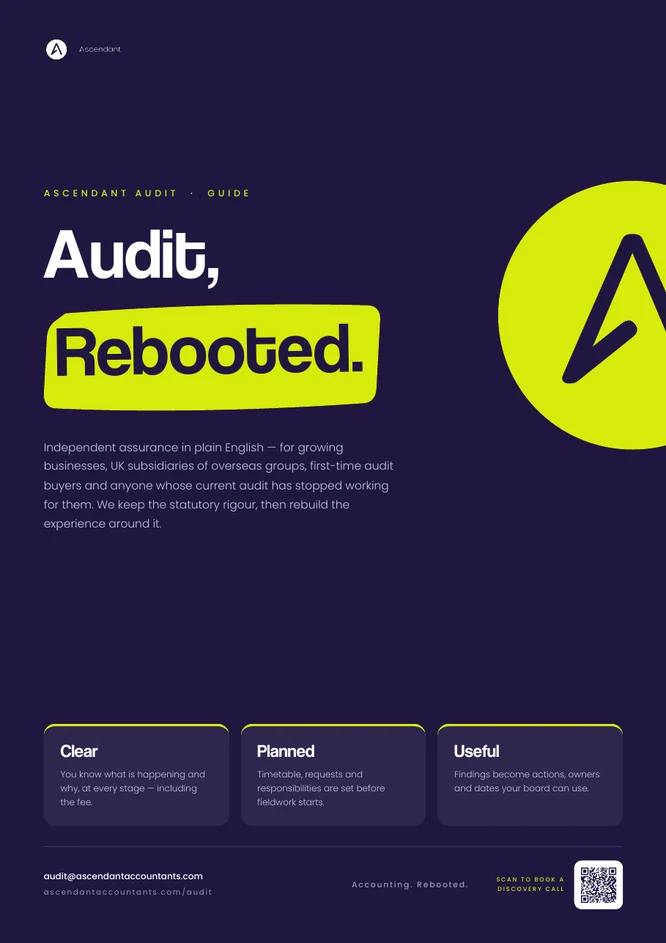
Audit Guide — Free Download
Audit, Rebooted.
Our audit guide in plain English: whether you need an audit, what moves the fee, how the work is planned, what you receive, and six questions to ask any auditor.
Your download link appears as soon as you send the form.
Questions
What boards ask before they appoint, or change, an auditor
What will you need from us?
Organised records before fieldwork: a reconciled balance sheet, the agreed PBC list, evidence for judgement areas, and someone owning each request. Your first statutory audit: the readiness checklist
What do we get at the end?
An independent opinion on whether your accounts are true and fair, plus a close-out that explains adjustments, management letter points and what to improve before next year. Your audit report, and what the opinion means
What isn’t an audit?
It isn’t bookkeeping, accounts preparation, a fraud investigation or management consulting. We challenge, test and report; we don’t make your decisions or run your controls.
How long does it take?
It runs from before year end (confirming the audit applies, the timetable, stock counts, the first PBC list) through fieldwork to close-out. First audits take longer, because opening balances may need evidence.
How is it priced?
By audit effort, not turnover alone: complexity, stock, contracts, systems, group reporting, deadlines and how ready you are. A good proposal shows the assumptions behind the fee and what would trigger more. Statutory audit fees, and what’s included
What should we ask before appointing an auditor?
What businesses like ours do you audit, and what are the main audit risks in our sector? What will you need before fieldwork, and how will queries be managed? Who will lead the work day to day? What assumptions sit behind the fee, and what would trigger more? What can and cannot you help with because of independence rules? How Ascendant answers them
What are the red flags?
Vague proposal wording, no clear timetable, no discussion of sector risks, a weak explanation of fee assumptions, overpromising on value-add without independence boundaries, and no plan for first-year opening balances.
Can we switch from our current auditor?
Yes. The new auditor makes a professional enquiry of the outgoing one, but the outgoing auditor has no veto: the incoming auditor makes their own acceptance decision.
When is the best time to switch?
Usually after the previous audit is complete and before planning begins for the next one. Switching close to a filing deadline is possible, but riskier.
Will switching make the next audit worse?
Not if the timing and handover are managed properly: the professional enquiry, access to prior-year information, prior-year issues, opening balances and an agreed timetable. Switching just to save money is usually a mistake; fit and process matter more.
Your kind of business
Auditors who know businesses like yours
Different businesses carry different audit risks, and an auditor who knows your business model finds them sooner.

SaaS, software and AI
Deferred income, contract terms and revenue recognition.

E-commerce
Marketplaces, payment processors, refunds, stock and VAT.

Professional services
WIP, accrued income, recoverability and lock-up.

UK subsidiaries
Group reporting packs, intercompany balances and parent deadlines.
Go deeper
Find your answer, then talk to us
Three decisions, and the pages that answer each one.
Choosing
01
Statutory audit services and fees
What’s included, what drives the fee, and what a proposal you can compare should show.
Understanding
02
How a statutory audit works
From scoping and planning through fieldwork to close-out, and how an audit compares with the other routes.
- Your audit report, and what the opinion means
- Your first statutory audit: the readiness checklist
- What the auditor tests: stock, payroll, revenue
Deciding
03
Do I need a statutory audit?
Size tests, timing, your group position, your articles and your shareholders: where you stand before a deadline decides for you.
- Statutory audit for your sector
- HMRC tax and VAT audits, and your statutory audit
Get started
Get an audit quote
Tell us a little about the business. An audit partner comes back within 48 hours with a scoped quote, or a call if it needs one.
Your audit, in a few questions
Every audit button on the hub comes here, so each enquiry is tracked from one place.
"*" indicates required fields