


The numbers
The small-company thresholds
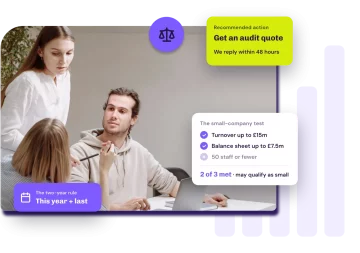
For accounting periods beginning on or after 6 April 2025, a company generally needs to meet at least two of these conditions:
£15m
annual turnover, at most
£7.5m
balance sheet total, at most
50
employees on average, at most
If the accounting period began before 6 April 2025, the previous thresholds may apply: £10.2 million turnover, £5.1 million balance sheet total and 50 employees.
Do not rely on turnover alone. Audit exemption depends on size criteria, timing, group position, company type, shareholder rights and sometimes the company’s articles or stakeholder requirements.
How the test works
The two-out-of-three test, and the two-year rule
The test is not “turnover above the threshold equals audit”. A business might be above the turnover threshold but still meet the asset and employee conditions. Equally, a lower-turnover business may fail the test because it has a large balance sheet and higher headcount.
Companies House guidance explains that, after the first financial year, company size is generally assessed by looking at the current year and the previous year. This can matter where growth is uneven or a company crosses the threshold for the first time.
Worked through
Simple examples
Two companies, for a period beginning after 6 April 2025.
REQUIRES AUDIT
£16m turnover, £8m balance sheet, 40 employees
- Turnover £16m: over the limit
- Balance sheet £8m: over the limit
- Employees 40: within the limit
Fails two conditions, so it doesn’t qualify as small.
EXEMPTED
£13m turnover, £4m balance sheet, 35 employees
- Turnover £13m: within the limit
- Balance sheet £4m: within the limit
- Employees 35: within the limit
Within the conditions, so it may qualify for small-company audit exemption.
A UK subsidiary in a larger overseas group needs a group-specific review before assuming exemption. Statutory audit for UK subsidiaries of overseas groups

Not sure which side you’re on? Tell us your year end and turnover, and we’ll check it with you.
Exceptions
OTHER REASONS FOR AUDIT
Group rules can change the answer
For accounting periods beginning on or after 6 April 2025, a group generally qualifies as small if it meets at least two of the following: aggregate turnover of no more than £15 million net or £18 million gross, aggregate balance sheet total of no more than £7.5 million net or £9 million gross, and aggregate average employees of no more than 50.
Shareholders can require an audit
Even if a small company would otherwise be exempt, shareholders can require an audit. The key threshold is at least 10%, and the request must be made in writing and delivered to the registered office within the required timing.
Companies that may not be able to claim exemption
Some companies cannot use small-company audit exemption even if they look small by size. Examples can include public companies, certain regulated financial services businesses, insurance-related entities, banking or e-money businesses, MiFID investment firms and companies in ineligible groups.
Local statutory requirements
Do not assume a UK subsidiary is exempt just because it looks small on a standalone basis. The company may be affected by group rules, ineligible group considerations, shareholder requirements, articles or parent expectations.
If it is new to you
If this would be your first audit
A first audit is usually harder than later audits because the business is learning the process and the auditor may need to validate opening balances from a previously unaudited period. Good planning can turn that into a controlled project.
The upside
Worth having even when it isn’t required

Lenders and banks
A lender may ask for audited accounts before agreeing or renewing facilities. Even where audit is not formally required, audited accounts can support confidence in the numbers. The audit does not make the business risk-free, but it can give the lender more comfort that the accounts have been independently tested.

Investors and shareholders
Investors often want confidence that revenue, margins, cash, debt, stock, WIP and balance sheet items are reliable. Shareholders may also want more transparency, particularly where they are not involved in day-to-day management.

Overseas parents and groups
Some UK subsidiaries are not legally required to have a local statutory audit but are still expected to produce audited accounts for group purposes. The voluntary audit needs to be aligned with parent reporting deadlines and group information needs.

Governance and growing up
Audit can help a business professionalise. It forces better documentation, stronger year-end processes and clearer accountability for key judgements. But audit is not a substitute for a strong finance function.
Our view
How Ascendant helps
Ascendant helps businesses turn threshold uncertainty into a clear plan. We look at size, timing, group structure, shareholder rights, sector issues and practical readiness. If audit is needed, we explain what happens next.
Your kind of business
Auditors who know businesses like yours
Different businesses carry different audit risks. Subscription businesses often need care around deferred income and contract terms. E-commerce businesses often need tight reconciliation across marketplaces, payment processors, refunds, stock and VAT footprints. Professional services firms often need clarity around WIP, accrued income, recoverability and lock-up.

SaaS, software and AI
Deferred income, contract terms and revenue recognition.

E-commerce
Marketplaces, payment processors, refunds, stock and VAT.

Professional services
WIP, accrued income, recoverability and lock-up.

UK subsidiaries
Group reporting packs, intercompany balances and parent deadlines.
General information, not advice
This article is general information only and should not be treated as audit, tax, accounting or legal advice. The right answer depends on the facts, accounting period, company structure and applicable professional requirements.